EVAR: Edge Visual Autoregressive Models
via Principled Pruning
ECCV 2026
1Zhejiang University, China 2Westlake University, China 3Snap Inc., USA
†Corresponding to: Huan Wang <wanghuan@westlake.edu.cn>, Guanzhong Tian <gztian@zju.edu.cn>
*Work done while Zefang was a visiting intern at ENCODE Lab, Westlake University.




Abstract
Next-scale visual autoregressive (VAR) models offer strong generative fidelity but remain computationally prohibitive for resource-constrained edge devices. We introduce EVAR, a structured-pruning framework tailored to next-scale VAR models. We find that standard pruning paradigms are poorly matched to multi-scale VAR architectures: rapid token growth at later scales dominates Hessian accumulation, marginalizing critical coarse scales and amplifying autoregressive error cascading. To address this issue, EVAR introduces Pyramid-Aware Optimal Brain Surgeon. Through pyramid-aware Hessian accumulation, Pyramid-Aware OBS rebalances scale-wise activation statistics and biases the solver toward preserving coarse-scale representations while maintaining an invertible Hessian estimate for closed-form weight compensation. Additionally, we propose Progressive Scale-Aware Distillation (PSAD) to counteract scale-wise gradient imbalance during fine-tuning. On ImageNet benchmarks, EVAR substantially reduces parameters and model footprint while retaining competitive quality. On an iOS deployment, EVAR further cuts single-image latency from 494 ms to 277 ms (1.8× speedup), with FID changing only marginally.
Method Overview
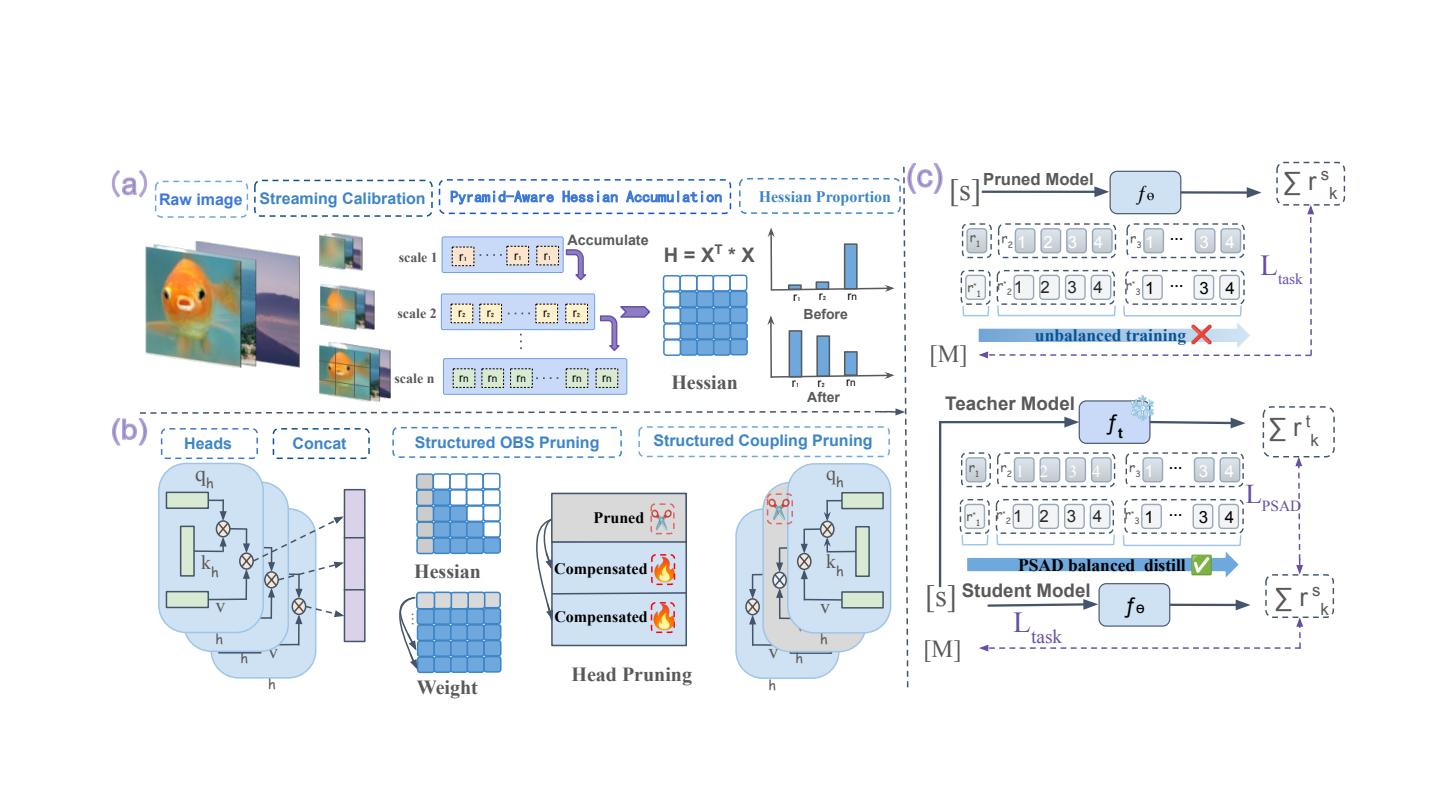
Figure 1: The overall pipeline of EVAR. (a) Pyramid-Aware Hessian Accumulation builds a scale-aware Hessian from multi-scale calibration tokens. (b) OBS-guided structured pruning removes coupled attention heads and FFN channels with closed-form compensation. (c) PSAD balances multi-scale distillation with scale-aware weighting and a coarse-to-fine curriculum.
Edge Deployment Results
iOS Deployment Performance
We deploy EVAR models on multiple iOS devices using the CoreML framework for CPU+GPU mixed inference. On the flagship iPad Pro (M4), EVAR achieves 1.8× speedup (494ms → 277ms). Notably, due to memory and computational constraints on mobile devices, the original 310M-parameter VAR-d16 model cannot run, and only the 40% pruned EVAR model (230M parameters) is supported. This finding underscores the necessity of model pruning for mobile deployment—through systematic pruning strategies, the EVAR framework enables high-quality visual generative models to achieve practical deployment on resource-constrained mobile devices for the first time. iPhone 16 Pro demonstrates excellent performance (580ms), while iPhone 12 Pro, as an older device, completes inference within an acceptable time frame (1778ms).
Cross-Device Inference Comparison
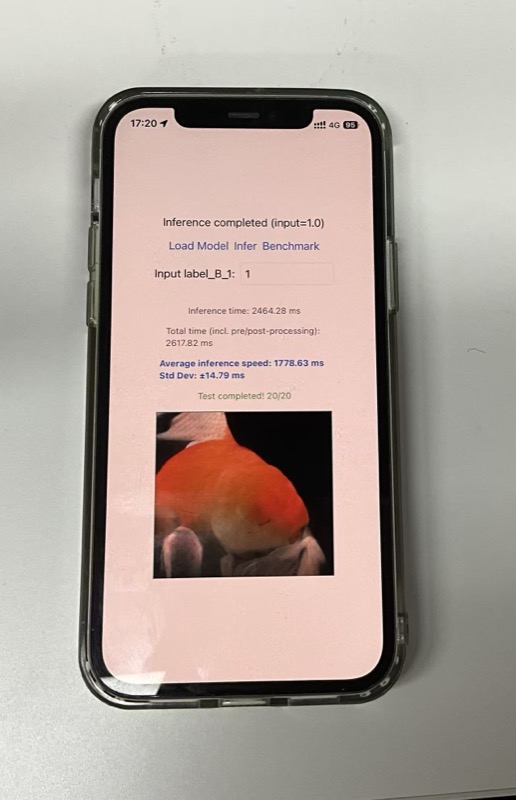
iPhone 12 Pro: EVAR inference results on older device
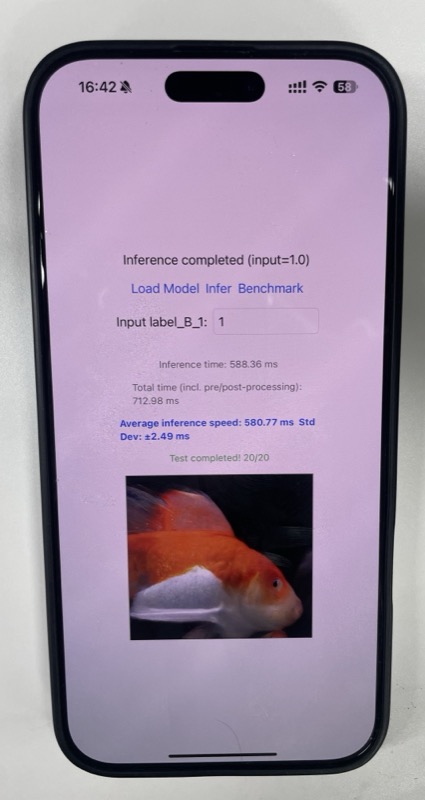
iPhone 16 Pro Max: EVAR inference results on latest device
EVAR demonstrates robust performance across different iOS devices, achieving consistent quality and real-time generation
Video Demo
Real-time Demo: EVAR running on iPad Pro (M4) showing 1.8× speedup and high-quality image generation